Who Gets to Say What's Real? The Complicated Truth About Cultural Gatekeeping in the Indian-American Community
The Moment It Gets Awkward
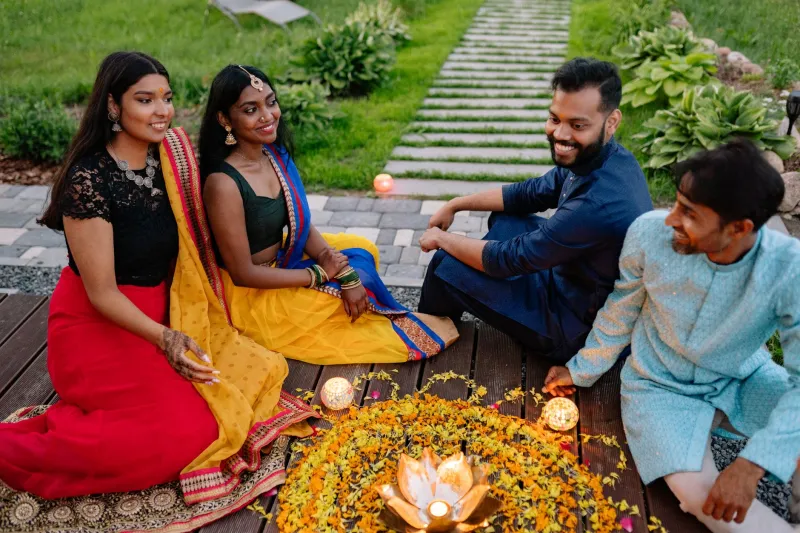
Picture this: you're at a Diwali party in Atlanta. Someone shows up wearing a lehenga, announces it's their first time celebrating, and asks if the rangoli is "like a mandala." Your Indian-American best friend, third generation, whose grandparents immigrated from Gujarat in the 1970s, visibly tenses. Later, in the car, they say something like, "I don't know, it just felt... off."
But here's the wrinkle: that same friend grew up eating pizza on Diwali, has never visited India, speaks maybe forty words of Gujarati, and once admitted they had to Google what Navratri actually was before their first garba event in college.
So who's gatekeeping whom? And does any of it actually matter?
The Authenticity Spectrum
The Indian-American community is not a monolith — a sentence that gets said a lot and still doesn't fully capture just how wide the range is. You have first-generation immigrants who moved here as adults and carry India with them in vivid, lived detail. You have 1.5-gen kids who came over young and live in a constant negotiation between two worlds. Then there are second, third, and even fourth-generation Indian-Americans whose relationship to the culture is real but mediated — through family stories, food, festivals, and fragments.
Each of these groups has a different relationship to the question of what counts as "real" Indian culture. And honestly? Each of them gatekeeps a little.
Take Priya, 29, a second-gen Tamil-American from the Bay Area. She's thoughtful about the distinction she draws. "I'm not trying to be the culture police," she says, "but there's a difference between someone engaging with Indian culture in good faith and someone who's basically using it as an aesthetic. When I see a non-Indian influencer doing a 'Bollywood-inspired' makeup look and getting a million views while actual Indian creators get ignored, that bothers me. That's not gatekeeping. That's just noticing a pattern."
Rohan, 34, second-gen Punjabi-American from Chicago, sees it differently. "My cousins in Delhi make fun of the way I do things. My American friends think I'm super Indian. I don't fully belong in either place. So when someone tells me I'm not Indian enough to have an opinion on my own culture, I really struggle with that."
The Non-Indian Variable
The conversation gets sharper when non-Indians enter the picture. Cultural appreciation versus appropriation is a debate that's been running for years in the broader American conversation, and Indian-American communities are very much part of it.
The consensus, to the extent one exists, seems to land somewhere like this: engagement is welcome, extraction is not. Wearing a salwar kameez to a friend's mehndi function because she asked you to dress traditionally? That's love. Selling "tribal Indian prints" on Etsy without any connection to or credit for the actual communities those patterns come from? That's a problem.
But even within that framework, there's a lot of gray. What about a non-Indian who genuinely loves Carnatic music, has studied it for years, and performs it publicly? What about a white yoga instructor who takes an annual trip to Rishikesh and teaches meditation rooted in Hindu philosophy? The Indian-American community doesn't agree on these cases — and maybe that's fine.
"I think we've been trained to have this binary conversation," says Ananya, 26, a third-gen Indian-American from Houston who studies South Asian cultural studies. "Either someone is appropriating or they're appreciating. But culture doesn't actually work that way. It moves, it shifts, it gets interpreted by different people in different contexts. That's always been true."
The Intra-Community Version Is Messier
Here's the part of the conversation that doesn't get enough airtime: a lot of the sharpest cultural gatekeeping in Indian-American communities isn't directed outward. It's internal.
Regionalism is real. A Malayali family in New Jersey will sometimes look sideways at a North Indian family's version of "Indian food." Caste dynamics that were supposed to stay in India have a frustrating habit of showing up at temple committees and matrimonial conversations. And the class divide between recent immigrants and long-established diaspora families creates its own flavor of "you're not doing this right."
Then there's the India-versus-diaspora tension. Indian nationals sometimes roll their eyes at diaspora Indians for being out of touch, performing a version of India that no longer exists, or clinging to cultural practices that have already evolved back home. Diaspora Indians sometimes push back that they've had to fight to maintain their culture in a context that constantly pressured them to assimilate — so maybe cut them some slack.
"My parents kept every tradition they could because they were afraid of losing it," says Meera, 31, whose family is from Maharashtra. "Some of what they preserved is actually more old-fashioned than what people in Pune do now. Does that make it less valid? I don't think so. It's just a different branch of the same tree."
When Gatekeeping Is Actually Just Protection
There's a version of this conversation where gatekeeping is the wrong word entirely. When a community that has historically been mocked for its food, its clothing, its accents, and its practices suddenly sees those same things become trendy — often without credit, often profiting people outside the community — the instinct to say "hold on, that's ours" is not pettiness. It's self-preservation.
The bindis-at-Coachella moment from a decade ago is a useful reference point. What bothered Indian-Americans wasn't that non-Indians found something beautiful in their culture. It was the asymmetry: the same kids who might have bullied a desi classmate for wearing traditional clothing were now wearing it as a festival costume, and nobody was making the connection.
That asymmetry still exists. And being aware of it — naming it, pushing back on it — isn't gatekeeping. It's accountability.
So Where Does That Leave Us?
Maybe the goal isn't to resolve the authenticity debate once and for all. Maybe it's just to have it more honestly — with more nuance, more humor, and less of the performative purity that can make these conversations exhausting.
Culture is not a museum exhibit. It's not fragile in the way people sometimes treat it. Indian culture has survived colonialism, migration, and decades of being filtered through a Hollywood lens. It can handle a little complexity.
What it probably can't survive — or at least, what the community doesn't have to accept — is being reduced to an aesthetic that other people profit from while the actual people who carry it get left out of the frame.
That's the line worth drawing. Everything else is probably worth a conversation over chai.